| |
The Knot of Heaven,
Its story and its history
Bernadette Brady MA
A question which is often raised in astrological fixed
star work is that, given that there are thousands of visible stars, how
does one choose which stars to use in a horoscope? A simple answer could
be that the brighter the star the more important its symbolism. However,
any astrologer who has worked with the stars will quickly find this a
simplistic approach, for although all the bright stars are rich in sky
symbolism, not all stars that carry strong symbolism are bright. One such
dim star is in Pisces and it is only magnitude 4.33. However, Aratus
considered it to be to one of the four great stars in the sky. This is the
star named Al Rescha, from the Arabic for “the cord”.
The star is described by Aratus (315 – 245 BCE) in his
Phaenomena ("Appearances") [1] the poem in which he described the
stars and constellations of the sky. This poem is one of the foundation
stones on which the 48 ancient constellations of western cartography are
based. Aratus wrote of the constellation Pisces as follows:
Still further in front of the Ram and still in
the vestibule of the South are the Fishes. Ever one
is higher than the other, and louder hears the fresh rush of the North
wind. From both there
stretch as it were, chains, whereby their tails on either side are joined.
The meeting chains
are knit by a single beautiful and great star, which is called the Knot of
Tails. [2]
Or another more recent translation by Godefroid de
Callatay reads as follows:
Even further in front of [the Triangle,]
but still in the entrance of the South are
The Fishes. One of them, which always
precedes the other,
Hears Boreas louder when it starts to come
down.
From both are stretched, as it were, the
chains
By which their tails, on each side, are
joined together in one point.
A single star holds them, a beautiful and
great star
Which is called the “Knot of the Heavens”.
[3]
Aratus named 48 constellations but only four
stars in the sky. He named the brilliant star Arcturus in the
constellation Bootes with a magnitude of -0.04. Arcturus is so bright that
it will catch the eye of any casual star gazer on a clear night. He also
named the beautiful star Capella in Auriga the Charioteer with its
magnitude of 0.08. This dominates an area of the sky about 90 degrees to
the east of Arcturus. He also listed the beautiful star Sirius, the
brightest star in the sky with a magnitude -1.46. Sirius is so bright that
the Egyptians called it The Scorcher and linked it with the Goddess Isis.
Lastly Aratus cited the mysterious Pleiades in the shoulder of the Great
Bull of Heaven, Taurus, with its seven twinkling lights. It is therefore
curious that into this illustrious group of stars Aratus placed a dim star
with a magnitude of only 4.33. Most of us in our city life would never
have seen this star. Even if you were far enough away from the city
lights, it is still only one of several hundred stars of between magnitude
4 and 5.[4]
We could dismiss Aratus’
fascination with this little star if his work had not proven to be so
significant in forming our western ideas of the constellations. His work
was reflected in Ptolemy’s Almagest where it was described as
“the knot which holds the fishes together”, a statement which suggests
that, by the 2nd century CE, Ptolemy may not have considered the star
important but he was at least acknowledging its culturally-established
position within the constellations. However, the Knot then became linked
with Ptolemy and his influence in western astronomy and astrology.
| Yet
all was not plan sailing for this little star. By the time of Erhard
Ratdolt, a German printer working in Venice who produced the first
printed star atlas in 1482, it was ignored. Ratdolt based his images
on the later Greek poet Hyginus (64BCE – 17 CE) whose work Poeticon
Astronomicon did not mention the knot. (see figure 1).
[Right. Figure 1 - The constellation Pisces from Erhard
Ratdolt’s 1482 version of the Poeticon Astronomican, void of
any connecting knot.]
However,
in 1515 when Albrecht Durer, the German artist and mathematician,
produced two polar projections of the celestial sphere, he carried on
Aratus’ description and displayed the two fishes of Pisces held
together by a large knot. (See figure 2).
|
 |
|

|
|
Figure 2 - Albrecht
Durer’s woodcut of the Northern Hemisphere sky, 1515. |
Since Durer’s work, which was
never published in book format, this small star has been honoured with
holding the knot of the fishes together, and it has been an honour which
has grown in celestial cartography.
|

|
|
Figure 3 - Johann Bayer, Pisces.
From his Uranometria (1603). |
In 1603 Johann Bayer produced his
Uranometria and in this he once again represents the star as a
great knot. (See figure 3).
 |
The last of the celestial atlases
which carried rich imagery along with the positions of the stars was
that of Johann Bode. In 1801 he produced the largest pictorial star
atlas ever printed containing over 17,000 stars and he displayed the
star as a large ornate knot with a rose clasp linking the two fishes
of Pisces. (See figure 4).
Undoubtedly Aratus’ consideration of this star as one
of his four great stars of the sky has become embedded in our western
cultural and maintained in the visual images of celestial cartography.
Yet the question still remains: why did Aratus consider such a small
star so important? The answer may lie in its unique position at the
time Aratus would have been looking at the sky. |
|
Figure 4 - Johann Bode, Uranographia,
1801.
Pisces and the Knot of Heaven |
|
The
Constellation Pisces and the Equator
When Aratus was writing his sky
poem Phaenomena the constellation Pisces straddled the northern and
southern hemispheres, with one fish being in the northern sky while the
other was in the south. It was indeed the only zodiacal constellation that
could claim equal membership of both hemispheres. Named The Swallows by
the Babylonians and The Fishes by the Greeks, there is a line of stars in
the sky which forms a “v” in the sky, and it is the star at the point of
the “v” which Aratus called the Knot of Heaven. (See figure 5). So one
explanation for the star’s importance is that it appeared to bind together
a constellation that straddled both hemispheres and thus it was a star
that could bind together both the northern and southern skies.
 |
 |
|
Figure 5 -
The constellation Pisces at the time of Aratus in 390 BCE with and
without the stick figure.
Use the image on the left to train your eye to see the constellation
in the image on the right.
The chain between the two fishes, one in the north and the other in
the south can be clearly seen. |
However, in 1996 Godefroid de
Callatay [5] suggested another solution to Aratus’ fascination with this
star and that was that for Aratus it lay upon the equinoctial colure.
The
Equinoctial Colure
The equinoctial colure is the name
given to the meridian circle (a circle that passes through the north and
south pole) which also passes through the point of the vernal equinox (the
0 Aries point in the tropical zodiac). The importance of this line, when
you are using observation to understand the sky, is that if a star
falls on this line, it can be used to point to the position of the vernal
equinox.
 |
Callatay pointed out that, for Aratus, this star in
Pisces did actually fall on this line. It therefore marked the point
where the equator crossed over the ecliptic, the vernal equinox. This
in itself may not have been so important except that it also marked
something else.
Wthin
Ptolemy’s model this star was recognized as the last star in Pisces to
rise above the horizon and thus considered to be the last star of the
zodiac. Al Rescha thus became, for Aratus, “The Knot of Heaven” as it
firstly, marked the alignment of the beginning and end of the year in
terms of the spring equinox; secondly it marked the joining point of
the band of the zodiac - Pisces to Aries; and finally it held the two
fishes together, one in the northern hemisphere and the other in the
south. Thus Al Rescha held the whole sphere together by Hemisphere,
Season and Zodiac.
(See Figure 6). |
|
Figure 6 -
The Equinoctial Colure for (396 BCE) for the time of Aratus. The star
in the knot of Pisces lies upon the meridian line which passes through
the vernal equinox which is the crossing of the ecliptic (pink line),
with the equator (blue line). |
Time has
broken the bond between Al Rescha and the spring equinox, and it has even
broken the bond between the two hemispheres, as now the constellation of
Pisces lies with both fish swimming in the northern hemisphere. However,
celestial cartography was, until the 19th century, an important cultural
carrier of sky mythology and star lore, and thus Aratus' Knot of Heaven
has been carried down to us via our sky maps.
Culture
and Symbolism
The story of this star provides us
with a rare insight into how a star gains symbolic and cultural
significance. The first step was that the star gained a proper name “The
Knot of Heaven” due to its important location in the sky at a particular
era. This name allowed it to be pictorially represented long after its
initial meaning had been lost, and in this pictorial format it was
culturally carried from one generation of cartographers to the next. Its
imagery culminated in the work of Bode in 1801 with a bejewelled knot in
the heavens.
However, although celestial
cartographers have carried this star forward, astrologers have tended to
ignore it. It was absent from William Lilly’s (1602-81) list of stars and,
apparently following his lead, later authors such as Vivian Robson (Fixed
Stars and Constellations in Astrology, 1923), Ebertin-Hoffmann (Fixed
Stars and their Interpretation 1971) and Joseph Rigor (The Power of Fixed
Star, 1979) all failed to mention it in their work. However, in more
recent times in my own work (Brady’s Book of Fixed Stars 1998) [6] as well
as in the work of other astrologers like Diana Rosenberg, we have returned
to the work of Aratus and the work of other celestial cartographers in
wondering about the symbolism of this small but apparently vital Knot of
Heaven.
The Knot
of Heaven and its links with Historical Events
Aratus told us that this star held
all the heavens together, and for astrology which seeks symbols, this star
potentially ought to carry the message of the joining of worlds, a point
in time and space where unity is made or broken. So in the following
examples from history where events were joined, we would expect to see Al
Rescha (The
Knot of Heaven)
prominent in some way.
The Battle of Milvian Bridge – 28 October, 312CE - Rome.
 |
Jupiter in paran with Al Rescha
In 312
CE Rome was in a civil war. The Emperor Constantine had a vision
which assured him that he should conquer in the sign of the Christ
and thus he ordered his warriors to mark their shields with the sign
of Christ and march on Rome. The battle occurred near the bridge
over the Tiber called the Milvian Bridge, and here Constantine was
victorious. In gratitude to the God of the Christians, Constantine
immediately declared that Christian worship was henceforth tolerated
throughout the Empire (Edict of Milan, early in 313). Christianity
was later adopted as the official religion.
This
was the joining of the Roman world with Christianity, a union that
is still strongly held. |
|
Conversion of Emperor Constantine, Print,
1869, Johnson, Fry & Company Publishers, New York |
|
Fall of
Constantinople - 7 June, 1453 (NS)
|

|
|
Saturn in paran with Al Rescha
The city of
Constantinople was the jewel in the crown of the Eastern empire and
stood at the crossroads between East and West. The fabled riches of
the emperor and the city made it a prize for invaders. This date is
set for the final assault and breach of the fabled indestructible
walls through which the Ottomans broke, signalling the end of the
city's thousand-year reign.
This was the end of the Byzantine Empire. Constantinople, now known
as Istanbul, is by its location an Al Rescha-like city as it sits at
the point of union between Asia and Europe. Its current struggle to
join the European Union is symbolic of the struggle of the two
fishes of Pisces when they sat in the two different hemispheres.
|
The
American War of Independence 19 April, 1775 , Concord, MA
Pluto in
paran with Al Rescha
 |
This was the skirmish between the British Army and
American patriots which marked the beginning of the American War of
Independence. Acting on orders from London to suppress rebellious
colonists, General Thomas Gage ordered his troops to seize the
colonists' military stores at Concord. En route from Boston, the
British force of 700 men was met on Lexington Green by 77 local
minutemen and other volunteers who had been forewarned of the raid
by Paul Revere.
With Pluto in paran to Al Rescha, we have the breaking
of a union, that of England and America. This conflict lead to the
eventual creation of the United States of America on the 4th July
1776 where by “coincidence” Jupiter was in paran with The Knot of
Heaven |
|
Minutemen facing British soldiers on
Lexington Common, Massachusetts, in the first battle in the War of
Independence, 19th April 1775. Original artist William Barnes Wollen. |
First Transatlantic Radio Message - 12 December, 1901 Poldu, Cornwall.
Neptune in paran with Al Rescha
|
Guglielmo Marconi received the first transatlantic
radio signal just after noon on 12th December, 1901. Criticism had
been levelled at his new wireless system of communication, saying that
it would only work as long as the two stations were in view of each
other. To disprove this he set up a station to send a Morse code "S" -
three dots - from the coast of Newfoundland to be received at Poldu,
on the coast of Cornwall, England, a distance of over 3,500 miles.
For three days the Newfoundland
station sent out the "S" signal, and for three days Marconi struggled
to raise aloft a giant kite which was his aerial. On 12th December he
was successful and received the three faint dots of the Morse code
“S”.
This signal opened the door to
global communications and linked together the New World on one side of
the Atlantic and the Old World on the other. |
 |
|
Guglielmo Marconi.
(Unknown photographer.) |
The
bombing of Pearl Harbour - 7 December, 1941 Hawaii
 |
Pluto rising with Al Rescha
culminating
(Note
above Pluto was
also in paran with Al Rescha at the start of
The American War of Independence)
On this day, a fleet of Japanese aircraft bombed the US naval
installation at Pearl Harbour in Hawaii destroying the US Pacific
fleet and killing thousands of military personnel. Known as the "Day
of Infamy", this heralded the USA's entrance into World War II.
When Pluto is in paran with Al Rescha over USA
latitudes it appears to represent times of vulnerability, for here
again it marked the US entry into conflict and this time binding it to
the new union of the Allied forces. |
| |
|
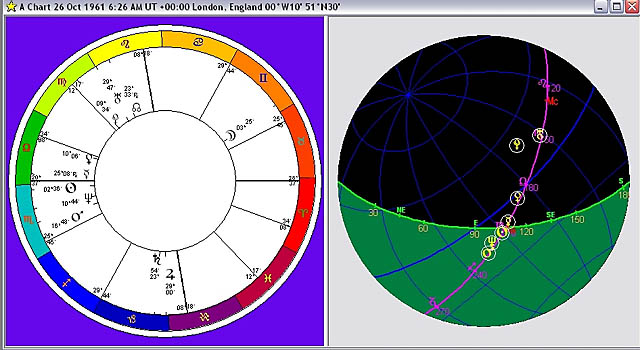
The
Construction of the Berlin Wall - 13 August, 1961, Berlin
Saturn culminating with Al Rescha rising
Early in the morning of Sunday, August 13, 1961, the
GDR, under the leadership of Erich Honecker, began to block off
East Berlin and the GDR from West Berlin by means of barbed wire and
antitank obstacles. Streets were torn up and barricades of paving
stones were erected. Tanks gathered at crucial places. The subway and
local railway services between East and West Berlin were interrupted.
Inhabitants of East Berlin and the GDR were no longer allowed to enter
West Berlin. In the days following, construction brigades began
replacing provisional barriers with a solid wall.
Saturn with Al Rescha was active with the fall of Constantinople, the
city that divided East and West. With this event a wall was used
to split a city and demarcate East Berlin from West Berlin, thus
becoming the face of the Cold War. |
 |
The handing over of Hong Kong - 1 July, 1997
 |
Neptune on the
IC with Al Rescha setting
The island of Hong Kong had originally been leased to the British
Government by the Chinese at the end of the 19th century. The island
was the last colonial outpost of the British Empire and when the
99-year lease expired, Britain relinquished her last overseas
possession.
This was the end of an era of a great naval empire.
It was also the beginning of a new union for the People’s Republic
of China. |
|
July 1, 1997: After
156 years of British rule,
China resumes sovereignty over Hong Kong |
|
People and the Knot of
Heaven
 |
Saturn culminating with Al Rescha
Charles
Henry Dow
- Born 6 Nov 1851 in Sterling, Connecticut. Dow was the creator of
the Dow Jones Stock Index first published in 1884. He also
developed a series of principles for understanding and analyzing
market behavior which later became known as Dow theory, the
groundwork for technical analysis of the stock market. |
|
|
 |
Saturn culminating with Al Rescha
John Kellogg –
Born 26 Feb 1852, in Tyrone Lake, MI. Kellogg is best
remembered as the father of the breakfast cereal and responsible for
the development of the breakfast food industry.
|
|
|
 |
Saturn setting
as Al Rescha was culminating
Guglielmo Marconi
- Born 25 April, 1874 in Bologna, Italy, best known as one of the
inventors of radio telegraphy. Marconi established the first radio
message across the Atlantic (referred to above). |
|
|
 |
Jupiter
Rising with Al Rescha Setting
Carl Jung
born 26 July 1875 in Kesswil, Switzerland, was a
Swiss psychiatrist and the founder of analytical
psychology. Jung's approach to psychology has been influential in
countercultural movements across the globe. |
|
|
 |
Jupiter
culminating with Al Rescha
Martin Luther King
born 15 January 1929 in Atlanta, GA,
was an American clergyman, and prominent leader in the
African-American civil rights movement. His main legacy was to
secure progress on civil rights in the United States and he is
frequently referenced as a human rights icon today.
|
|
|
 |
Uranus
culminating with Al Rescha rising.
Henry VIII of England,
born 28 June, 1491 in Greenwich, UK,
was a significant figure in the history of the English monarchy and
is popularly known for his political struggles with Rome. These
struggles ultimately led to his separating the Anglican church from
the Roman hierarchy, the Dissolution of the Monasteries, and
establishing himself as the Supreme Head of the Church of England. |
|
|
In Conclusion
The story of the dim star Al Rescha provides us with an
example of how a celestial object can become slowly embedded with
symbolism over 2000 years. The star's importance began with its ability to
mark a key point in the sky for Aratus – the union of the three great
spheres of the heavens. Although this mathematical or visual use was
forgotten, Aratus gave us or at least recorded its proper name “The Knot
of Heaven”. By owning a proper name which suggested a visual image it then
became culturally transmitted over several thousand years through the work
of cartographers, gaining its most elaborate representation in the last
great pictorial star atlas of Bode in 1801. Having been culturally
maintained and enhanced by cartographers from the ancient period to the
early 19th century, it then entered astrology in the 1990s. Now it has
found a home within the culture of western astrology and, since as
astrologer we seek symbolism in our "objects", the symbolism attributed to
it by Aratus and polished by the pens of several thousand years of
cartographers now resonates in historical events and people who have Al
Rescha in paran with their natal chart.
The stars only have meaning for us when they
carry our stories and the longer these stories are maintained and
polished by generations of humans, the deeper or more powerful their
symbolism becomes. It is not the brightness that is important for a star
but rather the polish it has received from the hands of humanity.
1.
Readers can see his full poem on this web site
http://ota.ahds.ac.uk/headers/0223.xml
2. Aratus (1989). "Phaenomena."
In Callimachus, Hymns and Epigrams Lycohpron, Aratus. Cambridge:
Harvard University Press. pg. 227.
3. de Callatay, Godefroid (1996). "The Knot of Heavens." Journal of
the Warburg and Courtauld Institutes Vol. 59: 1-13. pg.1
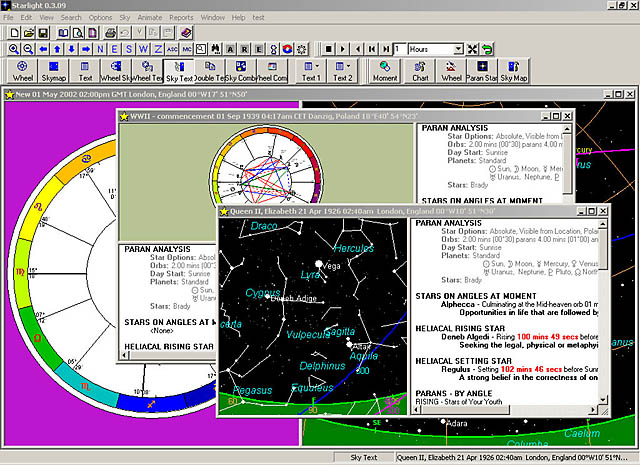
4. Starlight lists
1118 stars in its star catalogue which are between 4 and 5 in magnitude.
5. de Callatay,
Godefroid (1996). "The Knot of Heaven." Journal of the Warburg and
Courtauld Institutes Vol. 59: 1-13.
6. Brady, Bernadette.
(1998). Brady's Book of Fixed Stars. Maine,
USA: Samuel Weiser, Inc.pg 313.
|