Features
Nodes, Maps and the Horoscope: The Intentional and
the Unintentional. A exploration of the original use and
meaning of the nodes of the moon and a suggestion for a more
contemporary meaning.

StarLogos >>> 2010, the
2nd
Visual Astrology Conference 9 - 13 September, 2010, in Santa
Fe, New Mexico.
 |
This is a small conference, so places fill fast.
We are still 10 months out from StarLogos and already
25% of places have been booked.
If you are going to join us in Santa Fe, New
Mexico, USA 9 - 13 September, 2010 then join us
soon... |
Starlight for
Christmas?
We have a huge Starlight software sale on between now
and Christmas. You can pick up Starlight, the software that is
returning the stars and sky to astrology, for a good discount,
as well as supporting products, at up to 45% discount on some
items. If you want stars for Christmas, here is your
chance...click here.
Nodes, Maps and the
Horoscope The
Intentional and the Unintentional
Bernadette Brady
M.A.
 |
One of the features of astrology is
the horoscope itself, and although astrologies may vary
greatly from one culture to another and from one
historical period to another, the horoscope or map of
the heavens for a time and place, is one of the defining
features of what we know today as astrology. Maps tell
us where we are and sometimes when we
are, for maps are not just about space.
|
We have private maps filled with our
own topography of people, special places and events.
Maps can contain the personal sacred places of one's
joys or sorrows and we measure our orientation to these events
in time, how much time has passed since an event or how much
time is needed to reach an event. Maps and all their
variations are central to how we move through our lives.
Within astrology the horoscope is our map. It locates
us in a time and place and provides us with an orientation to
the rest of our universe. However, its brief extends far
beyond simply showing us time and space. It also informs us of
our relationship to that time and space and for many of us it
suggests ways of behaviour, ethics, and even our
responsibilities to our personal link with the cosmos.
|
In this way our horoscope provides us with a
philosophical, ethical, and even spiritual dimension,
and gives us an outline of the order of our lives in both
time and space.
In
short, our horoscope offers us a map of the meaning of
our life and in this regard it is a map of our personal
cosmology. |
 |
|
|
A feature of all maps, private, philosophical or even
spiritual and cosmological, is to define the limits of the
known world, the edges and the boundaries, the place where our
world ends and another may begin. If we do think of a chart
as a map of our personal cosmology, an interesting question
arises as to what in the astrologer's horoscope represents the
edges, the limits of the defined world?
To answer this question it is best to return to the origins
of astrology. In its beginnings astrology did not actually
include the concept of a horoscope, for the subject was born
in a culture of sky watchers and sky readers. Indeed the role
of the Mesopotamian astrologer-priest was akin to a sentry
standing guard, watching for signs of a return to chaos in the
heavens and thus, by reflection, chaos in the terrestrial
realm. The duties of these sentries were to help protect the
hard-won order gained by Marduk, the great hero, when he
slaughtered the dragon of chaos, Tiamat. Unlike the
later Greek cosmic myth of the Olympians overcoming the
Titans, the slaughtering of Tiamat was not the end of the
matter. It was an ongoing battle as there were times, such as
at an eclipse, when the Sun would once again wrestle with this
celestial dragon and chaos threatened to return.
 |
A Babylonian cylinder seal showing the
battle of Marduk and
Tiamat. |
These times of "order fighting chaos" were of great
concern to the astrologer-priest and for this reason by the
reign of King Ammisaduqa (1702-1682 B.C.E.) the forecasting of
eclipses was a large part of their focus.[1] By the
Neo-Assyrian period (912 - 612 BCE) astrologers had
identified the nodal axis, with its retrograde movement along
the path of the Sun, as well as the concept of the Saros
series of eclipses.[2] The nodal axis with its twin places in
the sky drifting slowly retrograde, was the place where chaos
could occur. Either end signified points in the sky,
'edges' or gateways, through which Tiamat could leap into the
world of order. Indeed the Moon's nodal axis still bears the
names of the dragon's head, Caput Draconis (North
Node) and the dragon's tail, Cauda Draconis (South
Node) reflecting its origins.
As the horoscope developed into a cosmological map rather
than a sky narrative, the important nodal axis was maintained
by the Greeks and placed into their new idea of the horoscope.
However, of all the changes in the use of horoscopes, the
nodes have probably undergone more variation in their
delineation than any other astrological point. For
example, the Greek astrologer Vettius Valens (120 -175 C.E.)
considered that the North Node acted as an amplifier of the
nature of any planet near it, good if the planet was a benefic
and bad if a malefic, and the South Node acted as a reducer of
the nature of such a planet, good or bad.[3] Seventeen
hundred years later, astrologer Dane Rudhyar (1895-1985) saw
the South Node as a negative place regardless of what planets
were near it and the North Node as positive.[4] In comparison
with these two ideas, in Jyotish astrology where the nodes are
called Rahu (North node) and Ketu (South node), both are
considered demons and thus both have a negative
influence.[5] Through the work of Alice Bailey
(1880 -1949) and esoteric astrology, the nodes in contemporary
Western astrology have morphed into either a concept of karma
where the North Node is seen as one's future life, or a
dimension of seeking one's spiritual fulfilment, and the South
Node is seen as that of the past, one's past lives or one's
family history.
|
Whichever way you wish to delineate the nodes in your
natal chart it is however, useful to consider them in
their original light as "the edges" of the ordered world,
the place where cosmos meets chaos. The nodes, for the
astrologer-priest of Mesopotamia were the location
within the map of the heavens which represented a place
where the known ended and the unknown began.
Within our own maps of the heavens therefore the
nodes can show us the edges of our world, the place
where it ends and other worlds begin.
Thus seeing the horoscope as a complex map of our place in
time, space and also the very meaning of our life, in other words a map of
our personal cosmology, then the nodes become the only
real contender for our map's 'edges'. |
 |
|
Tiamat, the harbinger of
chaos |
Taking this view of the nodes as the edges of our own
personal cosmology, I see them like two gates in the personal
'walled garden of paradise'[6] or the world that we know, with
each gate leading to different paths beyond it to the world
unknown. One such gate could be the place where we encounter
the new, where we feel the need to explore, and the place we
seek in order to colonize new territory in our bid to move
forward with our life. This is the gateway to the land reached
by our intent, our planned excursion, desires and adventures.
This gate is conscious, in front of us and with a large sign
reading 'Go this way!
 |
|
The North Node is the gate that
beckons us... |
The desire to colonize and move forward is a strong
compulsion within the human condition and this gate, which we
call the North Node, is the place on the edge of our cosmology
which calls to us in an irresistible manner. We are all drawn
forward in our lives to expand our world and this node informs
us of what and how we seek to do that. This
is the intentional way we bring new things into our world.
The other gate also opens to a path that leads outside our
personal cosmology. However, this gate does not call us
forward in a quest for adventure but rather sits quietly in a
dark forest, a gateway which is the opening into our world of
that which is not planned, that which is unintended. We come
across this place either by accident or when we are forced to
deal with it. This is the world of the unplanned.
 |
|
The South Node is the gate to a world of the
unintended, stumbled upon by accident not design.
|
It is a place where we do not feel comfortable because
we do not control it. It is the gate through which things can crash into our world,
unplanned, uncontrolled, unscheduled and definitely
unintentional. So the achievement or gains made in this place
are by accident rather than design. It is a gateway to a
territory which offers us confusion rather than
adventure. Yet within those woods lie unused resources
that are ours for the collecting if we are prepared to accept
the unscheduled chaos that has just crashed into our world and
learn skills we may not have intended to learn.
We often see the South Node as our past and sometimes as
our family history, as these can be often blamed for the
unscheduled, unplanned disruption to our ordered lives.
However, I think it is more interesting to consider it in a
neutral fashion - where the order of our world can be
disturbed, altered or even threatened in an unscheduled
manner. Only discovered by accident, this gate can be left
neglected, ignored or abandoned. Yet unforeseen events occur
and we find ourselves having to deal with things not of our
making and definitely not in our plans and the only effective
way forward is to let go of focused intent and allow the winds
of life to pilot our ship. Yet much can be gained when we find
ourselves standing at this gate. The South
Node gate is the way that things can enter your world which
are beyond your imagination, beyond your ability to conceive
of what you want in your life. It is the gateway that gives us the unexpected.
Therefore in keeping with the original use and meanings of
the Moon's nodes, as assumed by the Babylonian mythology, both
nodes can bring chaos into our lives but also both nodes are
the way that our world can expand with new ideas, skills and
concepts. One node offers us expansion of our world by focused
intent and the other by accident, one by the call to adventure
and the hero's quest and the other by disruption through
unintentional events.
Hence the North Node is discovery by intent; the South Node
is discovery by the accident.
Personalising astrological cosmology
Here are two examples illustrating this way of looking at
the nodes. Firstly, let us consider the location of the nodes
in the sky map of Barack Obama. At the time of his birth on 4
August, 1961, the North Node was moving over the star Regulus
in the constellation Leo. The place he wishes to influence, to
colonize and bring into his cosmology is represented by the
star Regulus, the place of the king.[7] So his intention is to
bring a new process to the idea of kingship and he actively
seeks leadership at all levels of his life. This is the place
where he battles, where he rises or falls, the place where he
brings order, or where chaos crashes into his world. The star
Regulus in the constellation Leo is the gateway to how he
moves forward in his life - he pursues leadership!
 |
His South Node is located amongst the stars of the
Urn of Aquarius - the urn of plenty. What he relied upon
as he sought the presidency was the wealth of his
nation. However, just as he engages in this battle for
leadership on a grand scale, he discovers that the
source of wealth is not as it should be and thus he is
forced to revisit this great Urn of Aquarius and find a
new way of restoring its balance. This was not his
dream, his desire but has happened to him by 'accident'.
|
In his position he has great power but this power is not
what will heal his nation's economy, the Urn of Aquarius. If
he is to achieve anything in this area he has to learn skills
and deal with issues which are out of his comfort zone and not
of his intent.
My second example is across the other side of the Atlantic
and is Queen Elizabeth II, born 21 April 1926. She came to the
throne at the time of the fading of the British Empire, where
the sovereign was an individual above taxation and whose
privacy was strictly guarded. Her North Node lies amongst the
stars of Gemini. Hence the place she wishes to influence, to
colonize and bring into her cosmology is represented by the
concept of polarities (Gemini). From seeing the monarchy as
separate, a situation of 'Us' versus 'Them', she has moved the
entire concept of the British Monarchy into the modern age of
communication, newspapers, internet and mobile phones and thus
reduced the difference between her family and that of the
British people. At times this struggle with the dragon of
Chaos has almost undone the monarchy, with scandals of leaked
phone calls, heightened media attention and a hunger by the
press for all things royal. However, somehow the Queen has
managed to bridge the gap between herself and the general
population by working with and understanding modern
communication. This has been her focused intent.
 |
Her South Node, however, sits amongst the stars of
the Cape of Sagittarius, the great warrior of the
heavens.
England had conquered a large area of the globe
through its military might. However, by the time she was
crowned this empire had been weakened and was morphing
into the Commonwealth of Nations. She has continued this
work of deconstructing Great Britain's colonial power
within the globe not by planned intent but rather by
responding to the needs of England's former colonies as
they arose. |
This is the area where she has had to find a different
solution by having to revisit the events of British Imperial
history and reshape her role and that of her nation's future
beyond the outdated world of Empire.
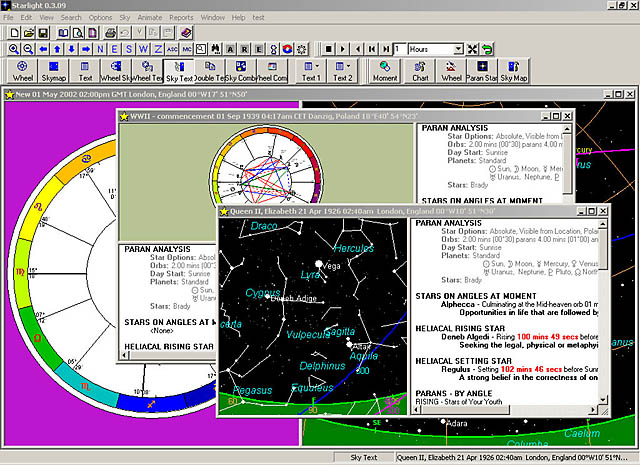
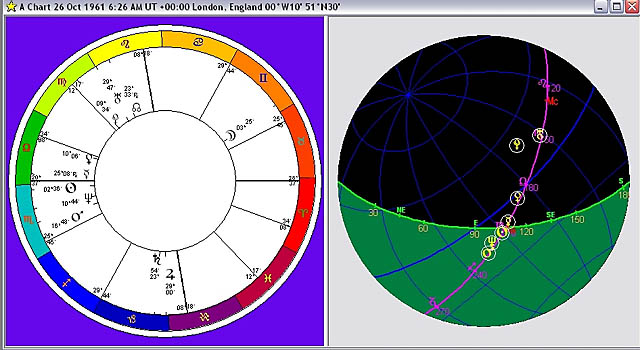
[NOTE: If you own Starlight, have a look at where your
nodes are in the sky. You can do this easily by opening your
natal sky map and finding the degree of your node on the
ecliptic. Or, you can open your chart and run it forward or
backwards in time to place the nodal axis on the
ascendant/descendant of your chart. Then look at the sky map
focusing on the horizon line. Where it cuts the ecliptic will
show you the stars and constellations around your North Node
and your South Node.]
If you know the stars around your nodal axis look at your
own North Node and think about what those stars represent. See
the star myths of this part of the sky as describing how you
seek to move forward in your life, what is it that provides
the drive and the quest to your life. Look at your South Node
and think about those stars as they will be describing what
you avoid, or feel uncomfortable around, where you feel you
have little or no power or control - where the unintentional
happens, good or bad. Both sets of star myths will show you
how things enter your world, one by intent and planning, the
other by the unplanned, the unintentional.
Transiting Nodal Axis
Apart from the personal natal delineation of nodes, there
is also the concept of the transiting node. This axis
highlights a place in the sky that suggests the nature of the
current struggle in the world, the theme that is filling the
newspapers, that which is taking our focus and where we reach
out to add to our world view, with potential success or
potential chaos.
In recent years the transiting North Node was moving through the
stars of the Urn of Aquarius, just as the South Node was at
the time of Barack Obama's birth. This began the issues with
the need to bring order into our
financial systems, the money matters or the wealth of the
communities. This is our intent.
What occurs by accident is represented by the South Node.
This was then completing its journey through the stars of Cancer,
the concept of family, of the small units within the larger
system. Thus the transiting axis was showing us the collapse of
the sub-prime lending system within the USA which lead to the
banking collapse, the unplanned and unscheduled event.
However, the South Node also suggested that by accepting this,
rather than blaming or disregarding, and considering the
wellbeing of the small units within the social system, the
whole structure can move forward. In reforming the world's
financial systems the world leaders are forced to consider
the wellbeing of the smaller human units in the equation,
rather than solely focusing on the large corporate
organisations. This will be interesting to watch.
As the transiting nodal axis retrogrades back through the
constellations completing a cycle every 18.6 years, its moving
point will reflect the shifts and changes within the world's
news events, providing us with the large background themes to
the emerging events on this small blue planet. In future
editions of the Visual Astrology Newsletter we will explore
this axis further.
The aim of this article, however, was to revisit the
meanings of the Moon's nodes and suggest that by returning to
their original meanings of the battle ground between order and
chaos, the edges of what is known and not known, we can gain
deeper insights which are free of ideologies or spiritual
overlays. We can, in fact, view them in a cosmological manner.
_____________________________________
1. Christopher Walker, ed. Astronomy before the
Telescope (London: British Museum Press,1996),
p.42. 2. Francesca Rochberg, The Heavenly Writing,
Divination, Horoscopy, and Astronomy in Mesopotamian
Culture (Cambridge, UK: Cambridge University Press,
2004), p. 138. 3. See the First Book of Vettius
Valens. The Anthology Book I. Trans Robert Schmidt. Golden
Hind Press, Berkely Springs, USA 1993. 4. Dane
Rudhyar, "The astrological study of psychological
complexes." http://www.khaldea.com/rudhyar/aspc/aspc_c13.shtml
5 Feb, 2008 5. James. T. Braha, Ancient Hindu
Astrology for the Modern Western Astrologer (Miami,
Florida Hermetician Press, 1986), p. 33. 6. see Bernadette
Brady, Astrology a Place in Chaos (Bournemouth, UK:
The Wessex Astrologer, 2006) for more on this concept. 7.
Brady, Bernadette, Star and Planet Combinations
(Bournemouth, UK: The Wessex Astrologer, 2008).

|