|
|
|
Loops in the Sky: when planets
tarry
Bernadette Brady
M.A.
When a planet goes retrograde, we all mutter various things
under our breath and consider that what is embraced by the planet’s
symbolism will be delayed or revisited.
However, in visual astrology the retrograde movement of a
planet is a different matter. The planet, which is considered a
vital character in the emerging sky narrative, stops, turns around
and then goes back to where it has been. Such a visual phenomena was
seen as the planet or deity stressing a certain part of the sky, or
waiting for another to catch up with it for an exchange, or backing
away from a potential conflict that it seemed to be rushing towards.
An unsigned letter from an Assyrian priest to his king, in
around 660 B.C.E. wrote about Mars not turning retrograde and said
[1]:
[Ma]rs has entered Cancer, but it will not be regarded as an
omen; it will not stand in it, it will not become stationary and
not tarry; it will move out
quickly.
This suggests that if a planet does “tarry”, then it is an
omen and was and maybe should be considered more carefully. So let
us look at where in the sky planets will linger and “tarry” in
2008.
The places where Mercury will
tarry in 2008. Mercury is the messenger, the thief
the rumour-carrier and will bring with it issues of information
being received, or revealed. But also it can be used as a like a
general highlight pen in the sky. Mercury tarrying amongst a set of
stars was a way that those stars were emphasized, either for good or
for bad, depending on the rest of the sky.
 |
Mercury Loops
First
retrograde loop: 28 January - 19 February in the
constellation of Capricorn.
This constellation is
the place of the law, where the establishment's power is
upheld. Mercury is going to stress the entire back of the
sea-goat, who was symbolic of Ea the god that comes out
of the water to teach and civilize his people. He later urged
his people to build an ark to escape the deluge.
We
could think of this as the king or the leaders being asked to
show "back bone" or the ruling forces - in any country - are
shown to be strong.
|
 |
Now this is an easy
statement to make but an astrologer/priest, I would think,
would see this as good for the "king".
Second retrograde
loop 26 May to 19 June – in the horns of Taurus.
Here Mercury rides up and down on the southern horn of
the Bull, pausing on the 19 June beside the fiery red eye of
Aldebaran.
This is a far more
worrying statement as these horns are a place of aggression.
Here Mercury is suggesting that there is talk of aggression or
news of war. Once again this can be an easy statement to make
as unfortunately there is always a war happening somewhere.
|
 |
Yet when this is
combined with a Jupiter retrograde loop which I consider
below, this combined symbolism indicates that the summer of
2008 is not going to be totally focused on the Olympic games
in China - unless of course this aggression can be soaked up
symbolically in the collective by all the heated competition
of the Games.
Third retrograde loop 24 Sept to 15
October in the left arm of Virgo.
This placement in
the wheat sheaf is a far gentler message suggesting talks of
peace. Whatever are the difficulties of summer they are calmed
by both Mars sliding into Virgo and being joined by Mercury.
Here Mercury is almost foretelling of a gift. One is tempted
to think of an Assyrian priest forecasting a good harvest and
much grain.
|
Venus and Mars do not make a retrograde loop this year,
although Mars has of course been stressing the horns of the
Bull and leaves that place at the end of January, and becomes
calmed by the stars of Virgo. Saturn is in midst of a
retrograde loop as we enter 2008 and will stay retrograde
until 3 May in the stars of Leo with its stationary point
close to Regulus the Heart of the Lion. I have discussed this
in the September
2007 VAN.
However, the other key retrograde
loop for 2008 is Jupiter when its tarries in the stars of
Sagittarius. |
Jupiter lingers in
Sagittarius
By the 9 May 2008 Jupiter slows and turns as it is
passing through Sagittarius. It then spends four months
lingering with the great aggressive and fearful archer,
finally to become stationary in his face. The stare of the
archer was the most feared part of the constellation. For the
Babylonians this was the warrior Pabilsag, who was
considered[2]:
".. Like a scorpion
rising up from among the thorns, he is a fearsome
scorpion; like a wolf rising up from his lair, he is
likely to growl; like a lion rising up in the pathway,
he is likely to beat
......."
Jupiter is the crown prince, the one who is
powerful but is at least one step removed from the throne; he
is the contender in politics, the outsider in political
campaigns. Yet he has power.
|
Thus from mid-June when Mercury sits on the eye of the Bull,
climaxing in late August to early September 2008 when Jupiter sits
in the face of the archer we have an aggressive summer, but as
Mercury moves into Virgo, and joins Mars in late September the most
difficult time should have passed, with Jupiter having turned direct
and "deciding" to leave his war-like position in
Sagittarius.
I have scanned the last 500 years and had not
found a similar time. Jupiter was in the stars of Sagittarius while
Mercury was rushing through the Bull and into Gemini in the summer
of 1593 which saw an invasion of the Netherlands, and the French
king Henry IV converted to Catholicism which I believe does not seem
to capture the themes of this 2008 narrative. So for me this is a
"wait and see" situation. In visual astrology I am certain that this
sky narrative would have caused a few letters to go to the king but
as to what those letters would have said, we will have to let time
tell us.
|
______________________________________ Sources: [1] Hunger, Herman. (1992). Astrological
Reports to Assyrian Kings. Helsinki, Finland: Helsinki University
Press. pg
260. [2] http://www.piney.com/BabPabNibru.html 10 April, 2007
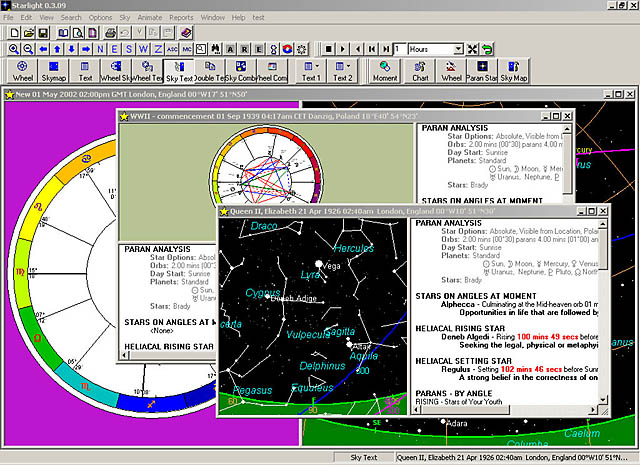
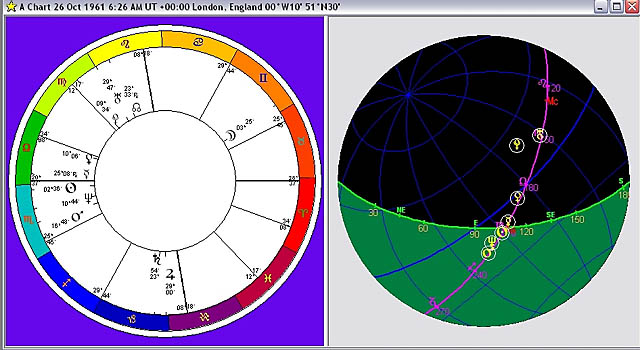
Images are composite
images made using Starlight Software (2002) Barnswood and Brady:Zyntara
Publications
“Two
households both alike in dignity…" A consideration of two
charts both containing Venus square Neptune by Darrelyn
Gunzburg
In this edition of the VAN I
want to look at two charts each with a Venus square to Neptune and
see how these aspects are modified not only by house position and sign but
also by the fixed star paran relationships involved with their natal
Venus.
The first Venus-Neptune
belongs to the great Italian operatic composer Giacomo Puccini (22
December 1858 – 29 November 1924) whose works include Manon Lescaut
(1893), La Boheme (1896), Tosca
(1900), Madama Butterfly (1904), Il Tabarro,
Suor Angelica, Gianni Schicchi: a trio of short works (1918) and
Turandot (1924).
The second Venus-Neptune
belongs to Sally Ride (b.26 May 1951) who, in 1983,
became the
first American woman to reach outer space as a mission specialist on the
Challenger, the seventh space shuttle flight.
 |
 |
|
Giacomo Puccini, 22 December, 1858. 2:00
am Lucca, Italy, Clifford data set. |
Sally Ride, 26 May 1951,
08:11am, Los Angeles, CA, USA. Blackwell Data set.
|
Natal
Venus-Neptune
As a general statement a
Venus-Neptune aspect in a chart describes someone who experiences a
confusion of value systems and human relationships, and is often termed
gullible or naïve due to an inability to distinguish with clarity where
relationships or friendships are supportive or non-supportive. In extreme
cases it can bring deception and disillusion into relationships; in its
best expression it can offer charisma in the arts or performance,
spirituality and even mathematics.
|
Puccini’s Venus is in
Sagittarius in the 2nd house and squares Neptune in the 5th house.
This succeedent square creates tension between what he values - to
relate independently (Venus in Sagittarius in the 2nd house) - and
what he creates – to merge with another or an ideal
(Venus-Neptune/Neptune in the 5th house). Throughout his life he
learns that if he takes creative, flexible action (mutable) and
pours this into his music (Venus-Neptune) and works with others
(succeedent), he can then be the one who inspires others (Venus in
Sagittarius square Neptune). |
 |
 |
Ride’s Venus is in the
1st house in Cancer square Neptune in the 4th
house. This angular square
creates tension between how she is seen by others and hence how she
impacts on the world (Venus in Cancer in the 1st house) – and how
she merges with another in the house and home (Venus-Neptune/Neptune
in the 4th house). The dilemma for Ride is that this is an angular
square and both planets make aspects to the Ascendant, hence it is
an empowered and effective part of her chart, yet the nature of both
Venus in Cancer and Venus-Neptune requires her to be
receptive. |
Clearly both of these
people have learnt how to gain the benefits of this aspect, as both have
achieved a place in history.
The Stars in
paran to Venus
So what more can one
learn by understanding the parans which lie underneath each of these
Venuses, and can they add to our understanding of these Venus-Neptune
squares?
|
Giacomo Puccini’s
Parans to his Venus
Giacomo Puccini
has three stars which connect with his Venus and all of them form
this relationship while culminating and thus will be most strongly
felt in the prime of his life.
Ras
Algethi is the star in the head
of the Kneeler, a star linked to the accepted order of things, the
natural and correct attitude of humans in awe of the gods or
goddess. This is the star which suggests that the way in which we
honour something larger than ourselves gives us a sense of purpose
to life.
It is in this period of
his life that Puccini starts to write his best works, beginning with
Manon
Lescaut which made him known
outside Italy, La bohème, widely considered his masterpiece,
Tosca, and Madama Butterfly. La
bohème, perhaps the most
popular and generally beloved opera ever written, is recognized as a
tour de force of characterization, sentiment, and craftsmanship.
Thus we see Puccini’s Venus growing in maturity and applying his
perception of people to his operatic work.
Capella is the
star in the left shoulder of Auriga, The Charioteer, and symbolizes
the need for freedom and independence. Linked to Artermis the Greek
goddess of the hunt, Capella is also the concept of the fertile
goddess, she who is of the horse, and therefore embodies action and
movement. Both of these meanings underlining Puccini’s natal Venus
in Sagittarius, suggest he requires a degree of freedom in the way
he composes his operas.
In 1880, at the
age of 21, Puccini composed the Messa, marking the
culmination of his family's long association with church music in
his native Lucca. The work anticipated Puccini's career as an
operatic composer by showing a dramatic power that was far more
operatic than was usual for church music. Thus Capella with his
Venus allows him the inner strength to compose in the way that best
suits his understanding and not be restrained or restricted by
social values, even though he was born into a family with five
generations of musical history behind them.
Rigel is the
bright star in the left foot of Orion the Hunter and is known as the
educator, for the Egyptians saw Orion as the Pharaoh and to be under
a Pharaoh's foot was to be under his protection. Rigel is the
active, educating concept of forward development not just for
personal gain but for the gain of many.
Rigel in paran
with his Venus in Sagittarius helps Puccini to bring out the
inspirational quality of his Venus and apply it to his music.
Some have noted that it
seems as if Puccini was incapable of writing an opera with a happy
ending. His heroines are usually tragic figures, doomed to
unhappiness and, often, an early death. In addition, many are flawed
in one way or another. Yet the fact that his characters are
imperfect gives them dramatic strength. |
Ras Algethi
with
Venus: Insightful
into the use of money, or colour; perceptive concerning the
nature of society
Capella with
Venus:
To
challenge the values of society
Rigel with
Venus:
Not
restrained by social opinions on ethics, relationship, or
religious issues

|
|
|
Puccini in summary
The Grove Online
Dictionary of Music [1] describes
Puccini’s unique talent, for which he
has been termed an unrivalled master, as being able fuse erotic passion
(Venus in Sagittarius), sensuality and tenderness with pathos and despair
(Venus-Neptune) so that others could be emotionally moved. Adding in
the fixed star parans attaches new insights and depths as to how Puccini
was able to express the more creative, inspirational side of his
Venus-Neptune, unrestrainedly challenging society (Rigel and Capella both in paran with Venus)
and applying his unique insights (Ras Algethi in
paran with Venus) to contribute to an art form that has and
continues to move and delight opera-lovers.
|
Arcturus with
Venus
A leader
in the arts or in humanistic politics

Rukbat
with Venus
To be
consistent, or rigid, in your social views and
ideas
Alpheratz with
Venus
To
demand the right to follow one's own social or religious
conscience
|
Sally Ride’s
Parans to her Venus
Sally Ride has one star
rising as it formed a paran with her Venus and thus its major
expression is in her youth
Arcturus is the
star in Bootes, the Hunter who now farms. He symbolises the
transition from the nomadic hunter-gather to the
herder-cultivator-ploughman-village, and represents one who can lead
the way as a pathfinder and make transitions to create a better way
of life for others.
At the age of 27, with
B.A., B.S., and masters' degrees, Ride was
a Ph.D. candidate looking for postdoctoral work in astrophysics when
she read about NASA's call for astronauts in the Stanford University
paper. More than eight thousand men and women applied to the space
program that year. Thirty five were accepted, six of whom were
women. One was Sally Ride. [2]
Many doorways opened up
as a result of Ride’s selection by NASA, one of which was to give
her a place in history. Although it could as easily have been
expressed as doing leading research a University (a post she took on
incidentally as Science Fellow at Stanford University once she had
retired from NASA), with Arcturus lying underneath her angular Venus
and making a wide conjunction to her Ascendant, it activates this
ability to forge a new pathway in the first third of her life,
rather than later.
Ride then has two stars
forming parans with her Venus while culminating which places their
expression in the prime of her life:
Rukbat is
the star in
the knee of the left foot of Sagittarius The Archer and represents
steadiness and consistency. Rukbat linked with Ride’s Venus, adds a
'rudder' or 'anchor' to her life, giving her the skill to work
towards long-term goals in her life.
Alpheratz is the
star
common to the Horse's navel and the head of Andromeda and symbolizes
freedom and movement. It fuels Ride’s Venus with the desire to take
action that comes from her conscience.

As director of the
California Space Institute and Professor of Physics at
the University of
California, San Diego she was able to pursue one of her passions,
encouraging young women to study science and math (Venus in Cancer in paran with Alpheratz).
She also initiated and headed EarthKAM, an Internet-based NASA
project that allows middle-school classes to shoot and download
photos of the Earth from space. Her most recent enterprise is
Imaginary Lines, an organization founded to provide support for all
the girls who are, or might become, interested in science, math and
technology. |
Ride in
summary
As part of her
training, Ride was the Capsule Communicator for the second and third Space
Shuttle flights and on June 18, 1983, she became the first American woman
in space as a crewmember on Space Shuttle Challenger: independent (angular
square) yet a member of crew which could only survive by being connected
to one another (Venus in Cancer square Neptune). As such it paved the way
for her to be able to follow her own pathway, focusing on nurturing not
only young people but women in science (Venus in Cancer in paran with
Alpheratz)
Finally...
As we
forge forward into this new-old area of bringing parans back into natal
chart delineation, I find it useful and informative to consider similar
aspects in the charts of people who have made a public mark and to look at
them not only from the similarities and/or differences in their natal
charts but also at what parans are sitting underneath the planets and how
this adds to the story.
|
Course
Information: Spring School - Learning how to read a
chart
If you
would like to learn how to read aspects in a natal chart, the
Astro Logos Spring
School, beginning
on Saturday 8th March and running for 6 weeks, will be
teaching exactly that.
The teaching will be through an
online, real-time environment as well as through lectures on CD and
will require short assignments of approximately 200-300 words to be
sent in each week to make sure you have understood the concepts
being taught. This is the gateway to the Diploma Delineation Course
run by Astro Logos which takes a full year in total through discrete
modules which connect with each other. Those who began with the 2007
Winter School last year are now completing the Delineation Work
Experience module and earning money from their readings. Here are
some recent comments from students that they were happy to share
with everyone in this newsletter:
“With
clarification and support from you, Darrelyn, I did my consult for
the client whose chart I asked about and it went really
well. So the "shocker" <grin> today was, I turned on my
cell phone and it beeped with messages. Would you believe, on
the final day of 2007, three new client
requests for astrological readings? It seems this is a good
marker for 2008!” Margaret,
Seattle, USA
“Just before Christmas
I was coerced into doing a reading for my parents’ conservative
friend's birthday at a dinner party full of conservatives who had
mostly never been exposed to Astrology except through magazine
horoscopes and I was sure had no respect for the art. I was so
intimidated at first- but I went in there with a "proud to be an
Astrologer" attitude and left with a lot of people seemingly in
awe! It was a great exercise for me to learn to not be so
judgemental myself. Astrology is something powerful enough to
cross cultural boundaries.” Eve, New
York
You can
find out more about the 2008 Spring School by clicking this
link.
Please note that we
assume that students are familiar with the techniques we teach in
the two Studyshop “The Zodiac” and “The Angles” and the “Planets and
Aspects Kit”. If you are not familiar with these you can explore
them and/or purchase them by clicking
here.
Medieval Astrology Diploma and
the Visual Astrology and Fixed Star Diploma
The courses are taught via lecture CDs, assignments and online
tutorials where questions are answered and charts are delineated
as a group. These diplomas are designed for those who already have
astrological experience as they focus on building new skills into
your current knowledge. Please note: Bernadette can only take on
four new Visual Astrology students and five new medieval students.
For
more information: Medieval Astrology www.astrologos.co.uk/courses_medieval.htm
or Visual Astrology Diploma www.astrologos.co.uk/courses_fixed_stars.htm
.
|
|
Receiving this
newsletter:
Some readers complain that they do not
receive the newsletter but with new filtering systems monitoring emails,
some of the people who wish to receive this newsletter are being blocked
by internet email filters. Thus in order to ensure that you are able to
continue to receive this newsletter, please add our email to your address
book: newsletter@Zyntara.com
Thank you. |
|